
|
10/9/01
Did Women Really
One of the most poisonous feminist fabrications over the past thirty years concerns our recent History. For example, for almost two whole generations now, our children have been fed the deceitful propaganda that marriage is a mechanism whereby men have oppressed women and, somehow, forced them to remain in the home, while they themselves ventured outside into the liberating world of work - presumably for fun, frolics, fulfilment and independence. the world of work has been, for the most part, an extremely unpleasant world The deceit herein is that, in reality, the world of work has been, for the most part, an extremely unpleasant world in which to live - until quite recently. The majority of men in recent History were working in terrible conditions - down filthy, dangerous mines - in the hot, unwholesome, poisonous construction industries of ship and house building, and in arduous heavy engineering projects such as building roads and bridges - in tedious, sweaty factories, labouring for 16 hours non-stop, day after day - in the military, sent away from home, sometimes for years, to the most inhospitable and hostile of conditions and climates, to face disease, damage, death, and war - in agriculture, where men toiled and tilled without the advanced machinery of today - and even in the new offices, where rows upon rows of clerks spent their hours laboriously copying out, by hand, the mountains of information that needed to be documented. In the world of work, men were being 'oppressed' far more so than were their women at home. In the world of work, men were being 'oppressed' far more so than were their women at home. They were at the beck and call of their bosses, and were given little in the way of rights, safety, security or decent pay. For the most part, therefore, the jobs of the past were mostly soul destroying, if not downright dangerous and debilitating, and it is men who did most of them in order to provide for their women and children. The world of work was not a pleasant place to be. And it was not somewhere where most women, then, or nowadays, would choose to have been. When feminists give the impression to our younger folk that working for a living in the recent past was invigorating, cathartic or therapeutic in some way, they are lying. In more recent times, technological advancements have removed much of the worst aspects of 'work', and, further, other huge industries requiring less odious forms of work have sprung up; e.g. media, computer, financial. And it is in these far more benign circumstances that today's women are continually indoctrinated with the view that some glorious world of 'work' was somehow denied to them in the past. The truth is that they were not denied it. They were saved from it. 5/1/02 In 1900, only 6 percent of married women worked outside the home Only 6% eh? Now that's interesting! ... ... And so is this ...
Here is an extract from David Thomas' book Not Guilty ... This was regarded as a huge step forward for womankind The desire to free oneself from work was common to all classes and both sexes. Dr Joanna Bourke of Birkbeck College, London, has studied the diaries of 5,000 women who lived between 1860 and 1930. During that period, the proportion of women in paid employment dropped from 75 per cent to 10 per cent. This was regarded as a huge step forward for womankind, an opinion shared by the women whose writings Dr Bourke researched. Freed from mills and factories, they created a new power base for themselves at home. This was, claims Dr Bourke, "a deliberate choice. . . and a choice that gave great pleasure." |
|
Teenage Girls Just Want to Marry and Stay Home Amelia Hill Sunday October 19, 2003 The Observer Their grandmothers fought for the vote, their mothers battled to have it all, but the upcoming generation of girls have decided to turn the clock back and just want stay at home with their babies. According to a survey of 5,000-plus teenage girls, their main ambition is to complete university then return to the homestead - whether their partners like it or not. More than nine out of 10 of the girls believe it should be up to their husbands to provide for them More than nine out of 10 of the girls believe it should be up to their husbands to provide for them, with 97 per cent disagreeing with the statement 'It doesn't matter who is the main earner, as long as we are happy.' More than 90 per cent of those polled for CosmoGirl magazine's November issue believe it is the man's role to provide the household's money, with 85 per cent maintaining they would rather rely on their partner for financial support than be a successful, independent woman. Instead of making a career for themselves, girls today plan to be married by the age of 25 - three years below the current national average of 28.2 years old. one in four say getting married is their number one priority in life. And although 43 per cent of those questioned believe they should continue with their education until they have achieved a university degree, one in four say getting married is their number one priority in life. The supposedly super-modern, 'fun comes first' teenage generation has proved to be remarkably traditional in every area of their beliefs, with over 50 per cent saying they would not dream of having children before seeing a ring on their finger. The desire to have children is kicking in earlier too, with the girls taking their 'ticking biological clock' cue from role models such as Kate Moss, Posh Spice and Reese Witherspoon and wanting to have their first child in their twenties. On average, teenage girls plan to have their first child at 26 and most plan to have one or two more children over the following four years, The national average now is 1.64 children per couple. 'This is so unsurprising,' said agony aunt and author Claire Rayner. 'The majority of girls have no glamorous future and nothing very special to look forward to. All they can hope for is their own man and their own baby - like their mothers and their grandmothers before them. 'This survey doesn't indicate that the battles of feminism have been lost,' she added. 'Feminism was never opposed to marriage or children. [AH: Rubbish; feminists have done everything in their power to destroy marriage] On the contrary, feminism was about equal opportunities for women to do what they wanted to do, when they wanted to do it, which is exactly what these girls are choosing to do.' |
|
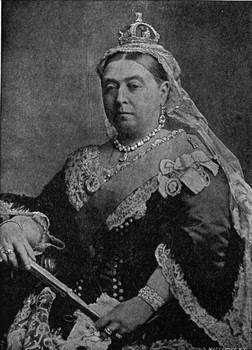
And now, study closely the words of one of the most powerful and influential women the world as ever known. "I love peace and quiet, I hate politics and turmoil. We women are not made for governing, and if we are good women, we must dislike these masculine occupations. There are times which force one to take interest in them, and I do, of course intensely" " I am most anxious to enlist everyone who can speak or write to join in checking this mad, wicked folly of 'Women's Rights', with all its attendant horrors, on which her poor feeble sex is bent, forgetting every sense of womanly feelings and propriety. Feminists ought to get a good whipping. Were woman to 'unsex' themselves by claiming equality with men, they would become the most hateful, heathen and disgusting of beings, and would surely perish without male protection." Queen Victoria 1870
Queen Victoria And when today's vindictive men-hating feminists purposefully distort the whole of our history in order to make you hate men, by telling you that men have always tried to hold women back, and were only, finally, defeated in this heinous operation by the feminists of the 60s and the 70s, please take on board the fact that it was WOMEN - influential women like Queen Victoria - who, rightly or wrongly, promoted whatever views of men and women people had in those earlier days. And so, for example, if women did not go out to work in greater numbers in those days it was because both men AND WOMEN thought that this was the best way to handle the circumstances in which they lived. the circumstances of women were CHOSEN as much by women as by men. So, when you listen to the media feminists, and to those who lecture on Women's Studies courses, take note on whether or not they EVER point out to you that, in recent history, the circumstances of women were CHOSEN as much by women as by men. And if they do not point this out to you, or if they even try to deny the huge influence that women have had in the past, then ask yourself why they do this. Is it because they wish to continue to engender hatred toward men by distorting the truth? Or are they just plain stupid? Ask them also, what jobs there were, realistically speaking, that were actually available, even fifty years ago, that women actually wanted to do, but were prevented from doing. There were some, yes. It was very difficult for a woman to become a doctor or a lawyer. But, firstly, how many women were actually affected by this? Very few indeed! There were not many such jobs around in those days. And, secondly, for the most part, only the well-heeled well-connected men near the top of the food chain could actually get such jobs. For 98% of men these jobs were just as unavailable as they were for women. it was mostly men, not women, who were actually discriminated against In fact, it was mostly men, not women, who were actually discriminated against when they were turned down for such jobs. Finally, feminists, with tiresome frequency, like to point out that women, even fifty years ago, were often forced to retire from their jobs to make way for the men if they became pregnant. And feminists have used this fact for 30 years as an example of oppression and discrimination. But it was absolutely the right thing to do. Can you imagine what would have happened to society - and to its women - if millions of unemployed men had been roaming the streets with nothing to do, with nowhere to go, with no money to pay for the bills for their families, their children and their sweethearts, while, among their very own neighbours, there were husbands and wives who BOTH had jobs and were doing very well thank you. Society would have lived its life completely enmeshed in crime, violence and mayhem. There was no modern police force in those days, no sophisticated communications technology, no major welfare benefits to be had, and so, no real protection whenever things went wrong. One only has to look at what happens in poorer sections of our own society to see what happens when men are not occupied in gainful employment and the children are not well looked after to see what would have happened to the entire nation if both men and women had not accepted the solution of giving men the priority when it came to allocating jobs. But, for thirty years, most of you will not have heard about any of this thanks to the hatred that feminists want to keep heaping onto the heads of men by preventing the truth from being told. |
|
Women Pulling Their Weight Here is an example of women pulling their weight in a manner which would have been unthinkable had they been truly oppressed ... Oh yes, and look at this, concerning domestic violence ... marked preponderance of husbands committed [to prison] for domestic violence ... Yep. That was the Austrian Netherlands, circa 1770 - a full 200 years before the vindictive feminists of the 1970's came on the scene. Finally, given that feminists have expended a great deal of their energy trying to engender male hatred by brainwashing women into believing that their lack of voting rights until the beginning of the last century is, somehow, strong evidence of oppression, it is worth pointing out that governments in those days hardly did anything. So there was nothing much to vote for! For example, ... In 1914, federal spending totalled less than 2 percent of GNP. Further, given that it was men who, by and large, had to defend and fight for the country, and that it was men, mostly, whose labours created the nation's wealth and built all the physical structures within it, and that it was men, mostly, who were expected to labour outside of the home in order to support the enterprises of the government as well as their families, it seems quite reasonable that men should have been the ones to decide the direction in which the economy would develop and to determine what governments could and could not do on their behalf. For example, why should women have had the right to determine whether or not men should be conscripted to go and die or to be maimed for their country in times of war? "Women received 34 percent of the bachelor's degrees in 1920 but only 24 percent in 1950." |
|
10/10/03 Ah yes. Those were the days when no-one cared for women. People only cared about the men. |
|
Also see, ... ... of 1853: The work of women and young persons was restricted to the hours between 6 a.m. and 6 p.m. There was no restriction on the work of men, however. They could be forced to work for much longer hours. And, ... |

AH's RSS Feed
Recent comments from some emails which can be viewed in full here. ...
"I cannot thank you enough."
"I stumbled upon your web site yesterday. I read as much as I could in 24 hours of your pages."
"I want to offer you my sincere thanks."
"Your articles and site in general have changed my life."
"I have been reading your articles for hours ..."
"Firstly let me congratulate you on a truly wonderful site."
"I must say there aren't many sites that I regularly visit but yours certainly will be one of them, ..."
"It is terrific to happen upon your website."
"I just wanted to say thank you for making your brilliant website."
"Your site is brilliant. It gives me hours of entertainment."
"You are worth your weight in gold."
"Love your site, I visit it on a regular basis for relief, inspiration and for the sake of my own sanity in a world gone mad."
"I ventured onto your site ... it's ABSOLUTELY BRILLIANT, and has kept me enthralled for hours!"
"I love the site, and agree with about 98% of what you post."
"I have been reading your site for a while now – and it is the best thing ever."
"you are doing a fabulous job in exposing the lies that silly sods like me have swallowed for years."

On YouTube ...
Who Rules Over Us?
Part 1 On Free Will
Part 2 On Super-Organisms
Part 3 On Power
Part 4 On Reality
Popular articles ...
... War on Drugs - Who benefits from the war on drugs?
... A Woman Needs A Man Like A Fish Needs A Bicycle - Surely, the evidence would suggest otherwise.
... Why Governments Love Feminism - It is mostly to do with money and power, not equality.
... The Psychological Differences Between Men and Women - Are women really more emotional than men?
... Equality Between Men and Women Is Not Achievable - especially since Hilary Clinton said that, "Women are the primary victims of war."
... Cultural Marxism And Feminism - The connections between Cultural Marxism and Feminism.
AH's RSS Feed