
|
SUMMARY OF FACTORY ACTS IN THE 19TH CENTURY UK Note: You will notice that as the UK government grew in power, so it attempted to protect women from exploitation by employers. Men, however, were not protected. And yet feminists continue to try to imbue women with hatred towards men by forever claiming that women were treated as second-class citizens. They were not. It is men who were treated as such. The earliest legislation on working conditions applied only to the cotton industry. The first Act to cover workers in other industries was the Mines Act of 1842. Gradually legislation was extended to other industries and smaller establishments. 1802: The Health and Morals of Apprentices Act. This applied to orphan apprentices in the textile industry. No children under the age of 9 were to be apprenticed and the working day limited to 12 hours with no night work. There was no system for enforcement. 1819: The Cotton Mills Act. This applied only to the cotton mills and restricted the working week for those aged 9 to 16 to 72 hours. No children under the age of 9 were to be apprenticed. No system of enforcement was devised. 1831: Cotton Mill Act. This act applied only to cotton mills and restricted the working hours for those under 18 to 12 hours a day. Night working was forbidden for those under 21. Once again there was no enforcement system. 1833: Factory Act. No children under 9 were to be employed except in silk mills. Those aged 9 to 13 were restricted to 9 hours a day and 48 hours a week with two hours school a day. Children and young persons were not to work outside the period 5.30 a.m. to 8.30 p.m. For the first time, factory inspectors were appointed. 1842: Mines Act. This stopped children under 9 and women from working underground. 1844: Factory Act (Mills). This act applied only to the textile industry and limited the work of children aged 8 to 13 to 6.5 hours a day, which was considered to be "half-time". 1845: Calico Print Works Act. This related to factories printing designs on cotton fabrics. Children under 8 were not to be employed. Those under 13 and women were not to work between 10 p.m. and 6 a.m. Children under 13 should attend school for 30 day per half year. 1847: Factory Act. Women and young persons in textile factories were limited to 10 hours a day or 10.5 if Saturday was a half holiday. This is sometimes known as the Ten Hour Act. 1853: Factory Act. This act related to mills and required that the work of children aged 9 to 13 be between the hours of 6 a.m. to 6 p.m. in summer and 7 a.m. to 7 p.m. in winter. Similarly the work of women and young persons was restricted to the hours between 6 a.m. and 6 p.m. 1860: Bleach and Dye Works Act. This brought factories engaged in bleaching and dyeing cloth under the same rules as textile mills. It did not apply to open air bleach crofts but an act of 1862 prevented night work at such establishments. 1864: Factory Act. Applied to pottery industry, match making, paper industry and fustian cutting. 1867: Factory Act. This brought any workplace employing more than 50 persons in manufacture under the factory acts. 1867: Workshops' Regulations Act. Workplaces with less than 50 persons were prevented from employing children under 8 years old. Children aged 8 to 13 were restricted to half time working. Young persons and women were restricted to a 12 hours day with 1 and a half hours allowed for meal breaks. Children, young people and women were not to be employed after 2 p.m. on Saturdays in establishments with more than five employees and child employees were to attend school 10 hours a week. 1874: Factory Act. This forbade employment of children in mills under the age of 9. In 1875 the age limit was raised to 10. Children aged 8 could still be employed in workshops and non-textile factories. 1876: Education Act. This act made school attendance compulsory for those up to the age of 10. Once over 10 a child could leave on attaining the school leaving certificate, also known as a Labour Certificate. Forster's Education Act of 1870 had not made school attendance either compulsory or free. 1878: Factory and Workshop Act. This act covered all mechanically powered textile and non-textile mills. Workshops were treated as non-textile factories. Domestic workshops were treated as for non-textile factories in relation to the conditions for children and women workers. 1891: Education Act. The age limit for starting half time work was raised to 11. The system of working half time continued until 1918. 1891: Factory and Workshop Act. Mothers were not to return to work within 4 weeks of giving birth. From 1893 the limit was raised to 11 weeks. |
|
Quote ... "The desire to free oneself from work was common to all classes and both sexes. Dr Joanna Bourke of Birkbeck College, London, has studied the diaries of 5,000 women who lived between 1860 and 1930. During that period, the proportion of women in paid employment dropped from 75 per cent to 10 per cent. This was regarded as a huge step forward for womankind, an opinion shared by the women whose writings Dr Bourke researched. Freed from mills and factories, they created a new power base for themselves at home. This was, claims Dr Bourke, "a deliberate choice. . . and a choice that gave great pleasure." |
|
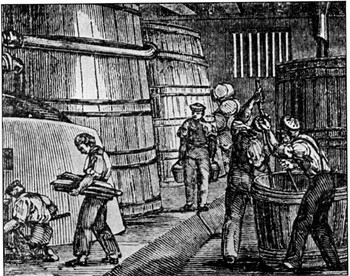
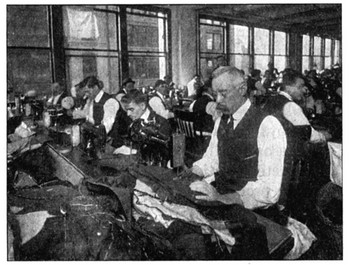
The Horrors Of Child Labour Two Centuries Ago Many would die from lung cancer and other diseases before they reached 25. For, shockingly, these human beasts of burden were children, some only five years old. Look at the pictures of the children. They were mostly boys. Look at the evidence yourself, and you will soon discover that it is men and boys who have suffered the most when it comes to 'oppression' and poor treatment. And if you are a young student who is being told otherwise by your feminist-controlled educators, then you are being lied to. |
|
Also see, ... |

AH's RSS Feed
Recent comments from some emails which can be viewed in full here. ...
"I cannot thank you enough."
"I stumbled upon your web site yesterday. I read as much as I could in 24 hours of your pages."
"I want to offer you my sincere thanks."
"I would just like to say that you are indeed a hero. "
"Your articles and site in general have changed my life."
"I have been reading your articles for hours ..."
"Firstly let me congratulate you on a truly wonderful site."
"I must say there aren't many sites that I regularly visit but yours certainly will be one of them, ..."
"It is terrific to happen upon your website."
"I just wanted to say thank you for making your brilliant website."
"I think I'm in love!" (from a woman)
"I love you. That is all. I love you!!!!" (from a man!)
"Your site is brilliant. It gives me hours of entertainment."
"You are worth your weight in gold."
"Love your site, I visit it on a regular basis for relief, inspiration and for the sake of my own sanity in a world gone mad."
"I ventured onto your site ... it's ABSOLUTELY BRILLIANT, and has kept me enthralled for hours!"
"I love the site, and agree with about 98% of what you post."
"I have been reading your site for a while now – and it is the best thing ever."
"you are doing a fabulous job in exposing the lies that silly sods like me have swallowed for years."
Tweet the article above to your followers ...

Or, to share the article with your social
media account click the
graphic below ...

Latest articles ...
The Psychological Differences Between Men and Women
Your Sexual Behaviour And Your Genes
Problems with Norton Internet Security?
AH's RSS Feed